
Lifestyle
Why is Nearsightedness So Common in East Asian Kids?


If you grew up East Asian, there’s a decent chance you remember a classroom full of kids wearing glasses, or eventually becoming one of them.
Turns out, there’s some real epidemiology behind that observation.
Myopia, better known as nearsightedness, has become extremely common in parts of East and Southeast Asia. Studies estimate that 80% to 90% of students leaving secondary school in some East Asian cities are myopic, with as many as 10% to 20% developing high myopia. (PMC)
Myopia happens when the eye grows too long, causing light to focus in front of the retina instead of directly on it. The result is familiar: nearby objects look clear, while things in the distance become blurry.
But myopia is more than just needing stronger glasses.
Higher levels of myopia are associated with an increased lifetime risk of serious eye conditions including retinal detachment, glaucoma, cataracts, and myopic macular degeneration, which can lead to irreversible vision loss. (PMC)
So why is it so common among East Asian children?
Genetics appear to play a role. Children with nearsighted parents are more likely to develop myopia themselves, but genes alone can’t explain how quickly rates have risen over the past several decades.
Researchers increasingly point toward a combination of intensive near work, education, urban environments, and less time spent outdoors. The rapid rise of myopia alongside changing lifestyles in East Asia has happened far too quickly to be explained by genetics alone. (PMC)
And yes, screen time may be part of the picture.
A 2025 analysis of 45 studies involving more than 335,000 people found that each additional hour of daily digital screen time was associated with 21% higher odds of myopia, with the association rising most sharply between one and four hours per day. However, because most of the underlying research was observational, the study cannot prove that screens themselves directly cause myopia. (JAMA Network Open)
One of the strongest preventive factors researchers have identified is surprisingly simple: going outside.
In a randomized trial involving nearly 2,000 first-graders in Guangzhou, China, schools added an extra 40 minutes of outdoor activity each day. After three years, 30.4% of children in the outdoor-activity group had developed myopia compared with 39.5% in the control group. (JAMA)
A 2024 Cochrane review similarly concluded that increasing outdoor time may help prevent children from becoming myopic, although the evidence is less certain about whether it slows progression once a child is already nearsighted. (Cochrane)
The International Myopia Institute currently recommends that children spend at least two hours outdoors each day to help delay the onset of myopia. Taking breaks from prolonged reading and screen use and avoiding extremely close reading distances may also help. (International Myopia Institute)
And for children whose prescriptions are already getting stronger, glasses aren’t necessarily the end of the conversation. Eye doctors now have several approaches designed specifically to slow childhood myopia progression, making regular eye exams especially important for children at higher risk.
Nearsightedness may be incredibly common in East Asian communities, but that doesn’t mean it should simply be accepted as inevitable.
For parents, something as simple as making more outdoor time part of a child’s daily routine may be one of the easiest ways to support their eye health for years to come.

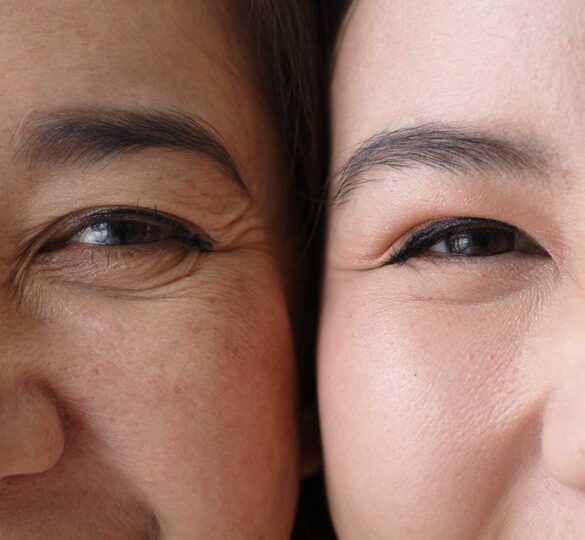
Glaucoma is often called the “silent thief of sight.” But there’s one type of glaucoma that Asian families may have particular reason to know about.
Primary angle-closure glaucoma is significantly more common in Asian populations than in many other groups, especially among East Asian adults.
A large systematic review estimated that more than 70% of people with primary angle-closure glaucoma worldwide live in Asia. Researchers also found that the condition becomes increasingly common with age and is more prevalent among women. (pmc.ncbi.nlm.nih.gov)
So what exactly is angle-closure glaucoma?
The eye constantly produces fluid that normally drains through a small area between the iris, the colored part of the eye, and the cornea. In some people, this drainage angle is naturally narrower.
If the angle becomes blocked, fluid cannot drain properly and pressure inside the eye can rise, potentially damaging the optic nerve and causing permanent vision loss.
Certain anatomical features that make the drainage angle narrower are more common in some Asian populations, which may help explain the higher rates of angle-closure disease. But risk varies substantially across Asia and between ethnic groups, so “Asian” should not be treated as a single uniform risk category. (pmc.ncbi.nlm.nih.gov)
Angle closure can also look very different from what many people imagine when they hear “glaucoma.”
Some people develop the condition gradually and may have few or no noticeable symptoms as their vision is damaged.
But if the drainage angle suddenly closes completely, pressure inside the eye can rise rapidly, causing an acute angle-closure attack.
Symptoms can include severe eye pain, blurred vision, redness, headache, seeing halos around lights, nausea, and vomiting. Acute angle closure is an eye emergency and requires immediate medical attention to prevent permanent vision loss. (aao.org)
The good news is that an eye doctor can identify whether someone has narrow drainage angles before an emergency ever happens.
During a comprehensive eye examination, ophthalmologists can examine the drainage angle using a technique called gonioscopy, which uses a specialized lens to see an area of the eye that otherwise isn’t directly visible.
Not everyone with narrow angles will develop glaucoma, and finding a narrow angle does not automatically mean someone needs treatment. Depending on a person’s eye anatomy and other risk factors, an ophthalmologist may recommend monitoring or preventive treatment.
Older age, family history, farsightedness, and female sex can also increase the likelihood of angle closure. (aao.org)
And because glaucoma-related vision loss is irreversible, catching disease early matters.
If glaucoma runs in your family, or you have parents or grandparents who haven’t had their eyes checked in a while, it may be worth encouraging a comprehensive eye exam.
For Asian families in particular, knowing that not all glaucoma is the same could help protect vision before symptoms ever appear.
Lifestyle
Bollywood Star Sonam Kapoor Becomes Dior’s First South Asian Global Ambassador
Sonam Kapoor has been named Dior’s global ambassador, becoming the first South Asian to hold the role.

Sonam Kapoor has been named Dior’s global ambassador, becoming the first South Asian to hold the role.
Renowned for her role in ‘Neerja’ and her influence as a global fashion icon, Kapoor will represent Dior’s womenswear collections designed by Maria Grazia Chiuri.
This partnership celebrates elegance and modernity in high fashion, as Kapoor continues to inspire in both the fashion and film industries, with her return to acting also highly anticipated.
See the official post on Instagram below.
Lifestyle
Renowned Japanese Artist Takashi Murakami Launches His First Footwear Brand ‘Ohana Hatake’
Celebrated Japanese artist Takashi Murakami has launched ‘Ohana Hatake,’ his debut footwear brand, blending his iconic flower motifs with new designs.

Celebrated Japanese artist Takashi Murakami has launched ‘Ohana Hatake,’ his debut footwear brand, blending his iconic flower motifs with new designs.
The collection’s name, which means “field of flowers” in Japanese, celebrates Murakami’s signature aesthetic, with the first releases featuring the Ohana Full-Bloom slides in “Apricot” and “Raspberry Rose” colorways.
Murakami shared, “I am pursuing an expression that explores the very relationship between American and Japanese cultures. I would love it if those who wear these sandals could sense how this team managed to craft something wonderful out of my quirky, off-the-mark ideas.”
See the official post on Instagram below.

An Evening with Team USA Fencing: Rooftop Recap | AsianFeed

Team USA Fencers Teach a Beginner How to Fence | AsianFeed

Team USA Fencers on the Olympics, Rivalries & AAPI Pride | AsianFeed
-

 Music5 years ago
11 Southeast Asian Artists You Should Listen to Right Now
-

 Music2 years ago
THE BLACK LABEL’s First Girl Group, MEOVV, Set to Debut with Their Single ‘Meow’
-

 Culture5 years ago
OG Asian YouTubers That Defined Your Childhood
-

 Culture3 years ago
Remembering 9/11 Hero Betty Ong, the Flight Attendant That Alerted the World to the Events on Flight 11
-

 Videos3 years ago
Get to Know Me: An-Li Bogan
-

 Culture2 years ago
Here’s a List of 10 Must-Watch Asian Romance Films to Watch This Valentine’s Day!
-

 Videos1 year ago
K-Pop Demon Hunters Interview | Arden Cho, May Hong, and Ji-young Yoo
-

 Movies2 years ago
Demon Slayer ‘Infinity Castle Arc’ Trilogy Confirmed